Signal Integrity Validation
Signal Integrity Validation

High-Speed Ethernet & InfiniBand Test Solutions: Scale-Out & Scale-Across Networking

Driven by the rapid growth of Artificial Intelligence (AI) and High-Performance Computing (HPC), modern data centers are evolving from traditional storage environments into high-throughput compute factories. As network architectures accelerate from 400G to 800G and toward 1.6T, high-speed interconnect technology has become a critical factor in determining AI training efficiency and system scalability.
As a trusted high-speed validation partner, iPasslabs provides comprehensive testing solutions for high-speed Ethernet, InfiniBand, optical/electrical integration, and signal integrity (SI) analysis, helping customers gain a competitive advantage in the global AI infrastructure race.
The trend of Data Center Connectivity: Optical and Copper Coexistence
Modern AI infrastructure is moving toward a hybrid connectivity model where copper and optical technologies coexist.
For short-reach applications, such as in-rack and server-to-server connections, copper-based solutions including DAC (Direct Attach Cable) continue to offer advantages in cost efficiency and low latency. For longer transmission distances, including inter-rack and scale-out architectures, optical connectivity becomes essential.
As AI clusters expand, AOC (Active Optical Cable) and high-speed optical transceivers are rapidly transitioning to 800G and 1.6T, driving a new generation of optical-electrical integration and higher bandwidth efficiency.
High-Speed Ethernet: The Foundation of 800G and 1.6T Infrastructure
High-speed Ethernet remains the backbone of cloud and AI data center infrastructure. Its open ecosystem and mature standardization make it the preferred choice for large-scale deployment and long-distance networking.
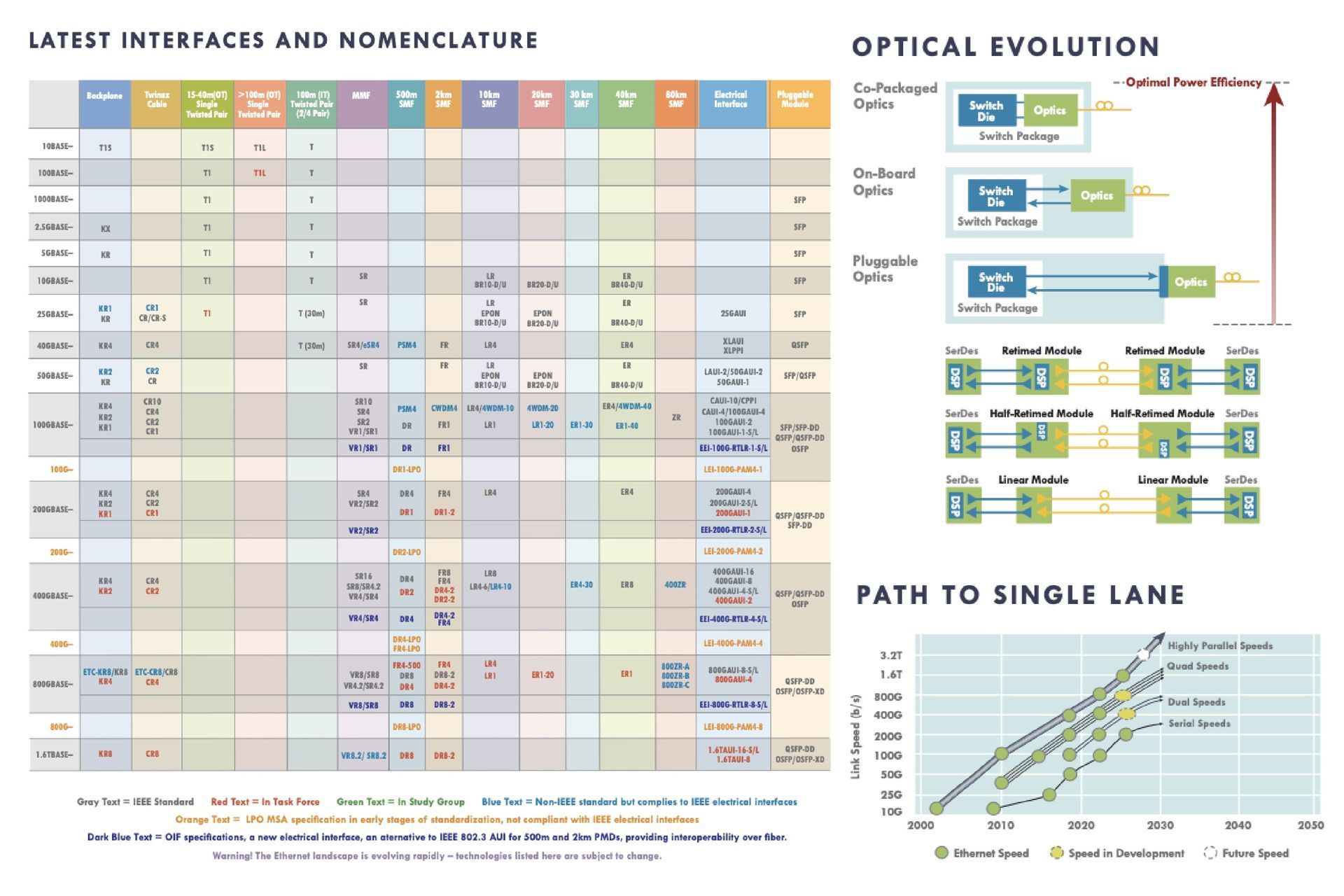
According to the latest IEEE 802.3 roadmap, Ethernet is advancing toward 1.6T architectures based on 200G PAM4 per lane, introducing unprecedented challenges for physical-layer validation.
In practical deployments, KR (Backplane) and CR (Copper Cable) interfaces continue to play critical roles. KR supports high-speed board-to-board communication, while CR is widely used for direct connectivity between servers and switches. As data rates increase, ensuring signal integrity across these interfaces becomes increasingly important.
InfiniBand: The Neural System of AI Supercomputing
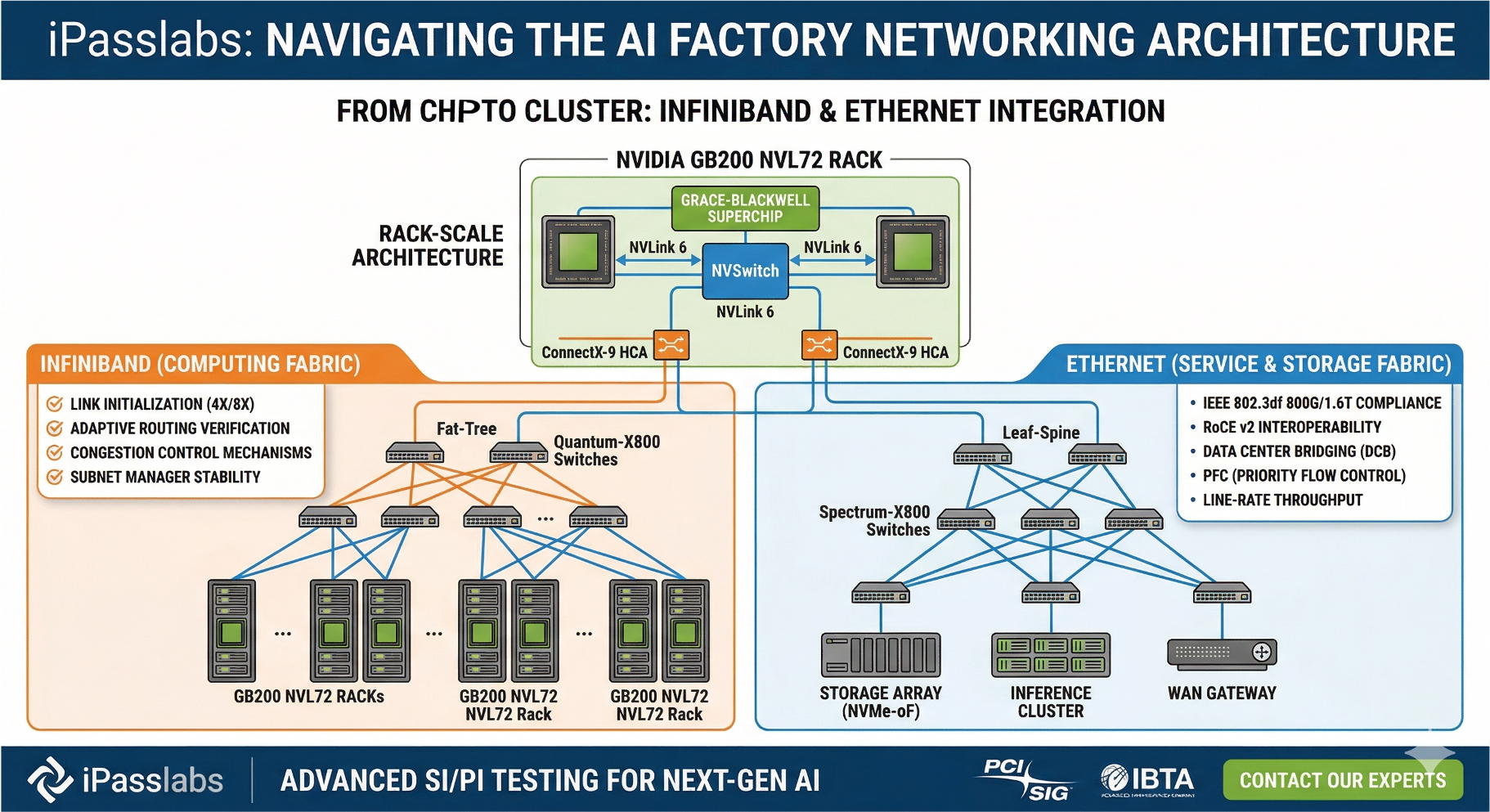
If Ethernet forms the backbone of the data center, InfiniBand serves as the neural system of large-scale AI clusters.
In GPU-intensive environments such as AI SuperPOD architectures, thousands of compute nodes must exchange and synchronize data with ultra-low latency. Through RDMA (Remote Direct Memory Access) and lossless networking, InfiniBand significantly reduces latency while maximizing data throughput, making it a key technology for AI training infrastructure.
With the introduction of InfiniBand Specification Release 2.1, the industry has entered the XDR (800G) era, featuring 200Gb/s PAM4 per lane. At these speeds, even minor jitter or noise can significantly impact bit error performance.
Comprehensive validation—including transmitter (Tx) eye and jitter analysis, receiver (Rx) tolerance testing, FEC performance, congestion management, and Virtual Lane (VL) optimization—has become essential to maintaining stable and efficient AI cluster operations.
Optical Communications and the Rise of CPO
As transmission speeds move beyond 800G toward 1.6T, traditional interconnect architectures face increasing limitations.
Copper transmission distance becomes constrained by signal attenuation, while pluggable optical modules encounter growing power and thermal challenges. In this environment, optical communication is no longer optional—it is fundamental.
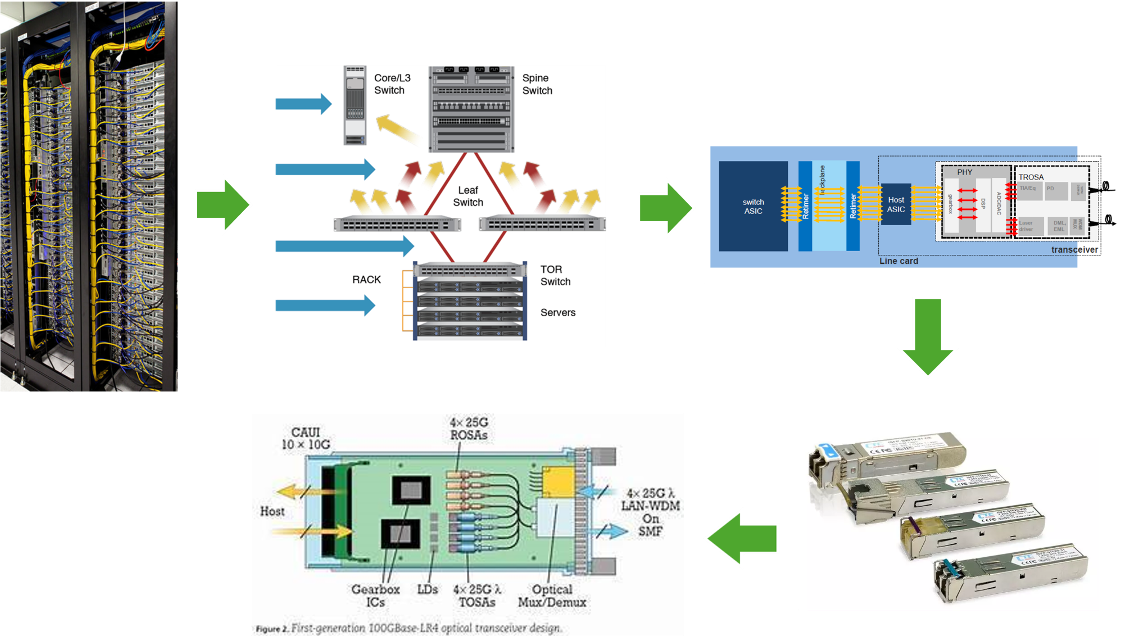
From QSFP-DD 800 transceivers to AOC solutions, the industry continues pushing bandwidth boundaries. At the same time, CPO (Co-Packaged Optics) is emerging as a key next-generation technology by integrating optical engines directly with switching ASICs on the same package substrate.
By significantly shortening electrical signal paths, CPO reduces signal loss and improves power efficiency—making it a critical enabler for future ultra-high-speed interconnect architectures.
Comprehensive Testing Capabilities from Electrical to Optical
iPasslabs provides end-to-end validation capabilities spanning both electrical and optical domains.
Our electrical testing services include:
- PAM4 signal analysis
- Eye diagram measurement
- Jitter decomposition
- Channel loss and impedance analysis
- Signal integrity (SI) simulation
- These capabilities help ensure reliable host-side signal performance for high-speed optical systems.
For optical validation, iPasslabs performs key measurements based on IEEE standards, including:
- TDECQ
- Optical power
- Extinction Ratio (ER)
- Relative Intensity Noise (RIN)
- Bit Error Rate (BER)
In addition, we provide interoperability testing to ensure stable operation across increasingly complex ecosystem platforms.
Accelerating Success in the AI Infrastructure Era
As AI infrastructure continues to scale, high-speed interconnect technology is no longer a supporting component—it has become a core competitive advantage.
The ability to maintain stable, scalable, and high-performance transmission at 800G and 1.6T will directly impact market leadership in the AI era.
As active members and working group participants of IEEE, PCI-SIG®, and IBTA, iPasslabs stays closely aligned with the latest industry standards and compliance requirements. Through comprehensive one-stop validation services, we help customers overcome design challenges, shorten development cycles, and accelerate time-to-market.
In the global AI compute race, iPasslabs is committed to being your most trusted validation partner.
Ethernet Standard Interfaces and Timelines