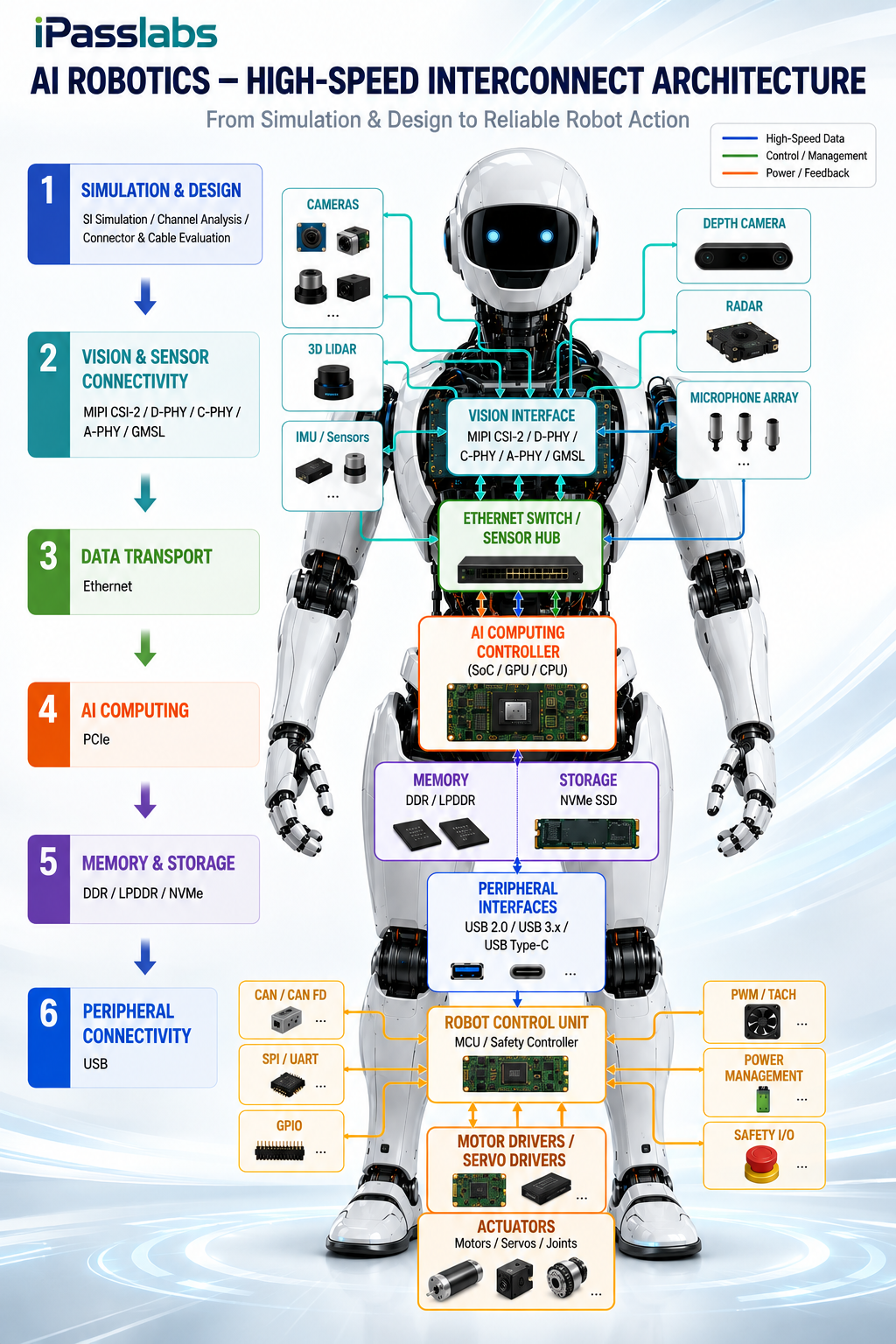


From Perception to Action: End-to-End High-Speed Interconnect Validation for Robotics

AI is rapidly moving from data centers into the real world, shifting from the cloud to the edge. The next wave of technology will increasingly center on hybrid AI architectures that combine different models for perception, language and action. This will give AI more than the ability to understand and generate information—it will also enable it to perceive the real world and respond in real time.
Physical AI is rapidly emerging. From humanoid robots and robot dogs to autonomous mobile robots (AMRs) and collaborative robots (cobots) in smart factories, AI robots are no longer limited to carrying out pre-programmed commands. They use cameras, LiDAR, inertial measurement units (IMUs) and other sensors to perceive their surroundings in real time. An AI computing platform then processes this data to identify, infer and make decisions, translating them into navigation, obstacle avoidance, grasping and motion control.
As AI computing power, camera resolution and sensor counts continue to increase, the volume of data that robots need to process and transmit is growing rapidly.
Behind an AI robot going from “seeing” to “acting” is a continuously operating, high-speed data chain:
Perception → Transmission → Compute → Storage → Connectivity → Control → Action
So the challenge for robotics products is no longer just “Is there enough AI compute?” More importantly:
Can large volumes of sensor data be transmitted to AI processors in real time, accurately and reliably—and can decisions be delivered quickly and reliably to the controls once processing is complete? From MIPI, GMSL, Ethernet, PCIe, DDR / LPDDR, NVMe and USB to CAN / CAN FD, every interface can affect an AI robot’s real-time responsiveness and system stability. That’s why high-speed interconnect validation is becoming an essential part of robot product development.
Start with simulation: identify high-speed signal risks before the design is complete
Compared with general-purpose computing platforms, robot hardware is often constrained by mechanical space, weight, and camera and sensor placement. It may require flexible printed circuits (FPCs), board-to-board connectors, I-PEX connectors, cables or other custom interconnect structures. When high-speed signals such as PCIe, MIPI and Ethernet pass through PCB traces, vias, connectors and cables, each structure can cause insertion loss, return loss, signal reflections, crosstalk or impedance discontinuities—reducing high-speed signal margin.
That’s why iPasslabs can use signal integrity (SI) simulation and channel analysis early in product design to help development teams assess:
- PCB Traces and Vias
- Connectors and Cables
- Insertion Loss / Return Loss (S-Parameters)
- Impedance
- Crosstalk
- Eye Diagram
- Channel Margin
Identify potential design risks early, from the Pre-Sim and Post-Sim stages, to reduce PCB redesign costs and development time.
Vision and Sensing: Helping Robots “See—and Send the Data Back”
Vision is fundamental to how AI robots perceive their environment. Whether identifying objects with a humanoid robot, sensing the environment with a robot dog, or navigating and avoiding obstacles with an autonomous mobile robot, applications may rely on multiple high-resolution cameras continuously capturing their surroundings. But capturing images is only the first step.
The real challenge is reliably delivering large volumes of visual and sensor data from cameras and sensors distributed throughout the robot to a central AI computing platform.
A robot vision architecture may therefore involve several interfaces at once: MIPI CSI-2 / D-PHY / C-PHY / MIPI A-PHY / GMSL
MIPI CSI-2 with D-PHY / C-PHY supports high-speed camera data transmission. For applications where cameras are farther from the central compute platform, MIPI A-PHY or other long-reach SerDes architectures may be used.
From physical-layer validation, signal integrity, timing and jitter to cables, connectors and channel analysis, iPasslabs helps customers assess high-speed signal quality across the entire visual data path.
From the camera to the AI processor, helping robots not only “see” but also ensuring image data can be reliably transmitted.
Data Transfer: How Can Large Volumes of Sensor Data Reach AI Processors in Real Time?
As AI robots are equipped with multiple cameras, 3D vision, LiDAR and other high-bandwidth sensors, data transfer between sensors and the compute platform becomes increasingly important. In real-time AI perception applications, the system needs to quickly deliver large volumes of sensor data to AI processors to minimize data transfer and processing latency. As a result, high-speed Ethernet is becoming a key data backbone for robot sensor networks and edge AI computing platforms.
iPasslabs provides transmitter and receiver validation, signal integrity, jitter, bit error rate (BER), and channel analysis for high-speed Ethernet physical layers. We help development teams verify physical-layer signal quality under heavy data traffic.
For AI robots, networking is about more than just getting online—it can be a critical high-speed path for sensor data to reach AI processors.
AI Computing: PCIe Connects a Robot’s High-Speed Compute Resources
Once sensor data enters the system, its next stop is AI computing.
In high-performance robotics platforms, PCIe can connect AI systems-on-chip (SoCs), GPUs, FPGAs, AI accelerators, network interface cards (NICs), NVMe SSDs, and other high-speed expansion devices.
As PCIe speeds continue to increase, PCB layout, vias, connectors, cables and different interconnect structures have a greater impact on signal integrity.
iPasslabs offers:
From channel analysis during the simulation and design phase to real-world physical-layer electrical validation at the prototyping stage, we help development teams verify PCIe signal quality and design margin.
Robotics platforms often use non-standard connectors or cable configurations due to space and mechanical constraints, making cross-validation of high-speed channel performance through simulation and real-world measurements especially important.
Memory and Storage: Powering the Data Exchange Behind AI Computing
AI computing needs more than processing power—it also needs high-bandwidth memory and storage.
Camera footage, AI models, 3D maps, sensor data and system logs all require high-speed memory and storage devices for continuous read and write operations and data exchange. That’s why next-generation edge AI / robotics platforms are increasingly adopting:
DDR / LPDDR / PCIe NVMe SSD
iPasslabs provides DDR / LPDDR signal integrity validation, analyzing timing, eye diagrams, jitter and signal quality for high-speed signals such as CK, DQS, DQ and CA.
For NVMe SSDs, we validate storage connections from the perspective of the PCIe physical layer and channel.
Peripheral Connectivity: USB Connects More Sensors and Peripherals
In addition to high-speed cameras, networking and storage devices, AI robots also need to connect to a wide range of peripherals.
USB cameras, depth cameras, sensors, external storage devices, debugging equipment and other peripherals may all connect to the robot controller via USB.
iPasslabs offers:
USB 2.0 / USB 3.x / USB Type-C Physical-Layer Validation
High-speed physical-layer validation of transmitters, receivers, eye diagrams, jitter and timing helps verify signal quality and connection reliability for different USB peripherals on the robot platform.
From design to system, from perception to action.
Through simulation analysis and high-speed interface validation, iPasslabs helps robotics development teams identify design risks earlier, shorten debugging and validation cycles, and accelerate the journey from design to reliable real-world applications for next-generation AI robots.